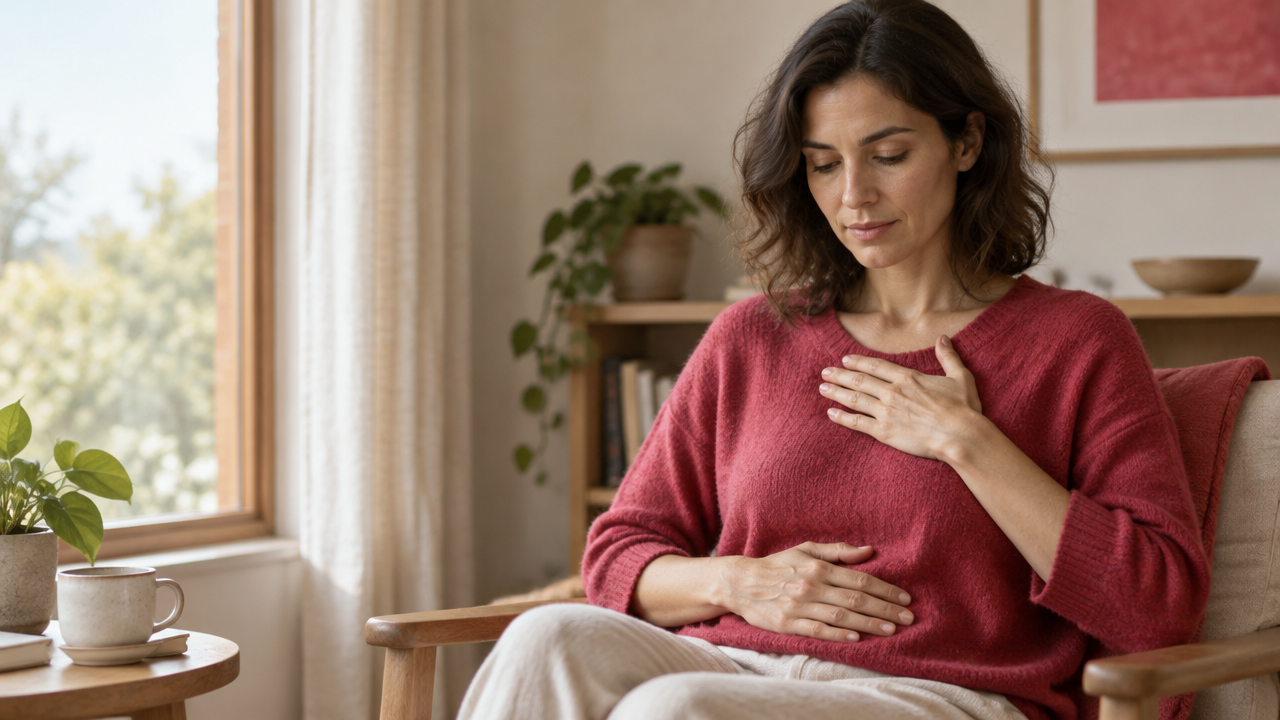

We know the feeling. A meeting is still an hour away, yet the body acts as if the hard part has already started. The jaw tightens. The chest gets shallow. Thoughts begin to rehearse what might go wrong. This is anticipatory stress, and at work it often appears before presentations, reviews, calls, deadlines, or hard talks.
Slow exhale rituals are short breathing practices that lengthen the out-breath to calm the body before stress peaks.
We think this matters because stress does not only come from events. It also comes from our inner preparation for events. Many people do not break down during the meeting itself. They get worn down in the thirty minutes before it.
A slow exhale ritual gives that waiting period a new shape. Instead of sitting in silent tension, we create a pattern. We breathe in with ease, and we breathe out a little longer. The body reads that signal. Often, it softens.
Why the exhale helps before pressure
When we are tense, breathing often gets quick and high in the chest. That style of breathing can feed the sense that we are under threat. A longer exhale tends to send the opposite message. It tells the nervous system that we are safe enough to slow down.
The long exhale works like a brake for the stress response.
In our view, this is why exhale-based rituals fit the workday so well. They are discreet. They do not need special equipment. They can happen at a desk, in a restroom stall, in a parked car, or while waiting for a video call to begin.
There is also good support for breathwork in general. In a meta-analysis of 12 randomized controlled trials, deliberate breathwork showed a small-to-medium pooled effect for lowering self-reported stress compared with control groups. We should be careful not to treat breathing as magic, but the direction is clear. It can help.
Slow the exit. Calm follows.
What a ritual changes
A ritual is not just a technique. It is a cue, a sequence, and a meaning. At work, this matters more than people think. If we only breathe when we are already flooded, we may forget or rush it. If we attach a simple exhale ritual to repeat events, it becomes easier to trust and repeat.
We have seen this in ordinary moments. A person closes all tabs before a client call, places both feet on the floor, and takes five slow rounds of breathing. Another person stands by the window before opening a difficult email. Small act. Real shift.
A useful ritual often includes three parts:
A clear moment to begin, such as before opening a calendar invite.
A set number of breaths, so there is no guessing.
A closing action, such as relaxing the shoulders or starting the task.
This structure reduces mental noise. We do not ask, “Am I calm yet?” We simply complete the sequence.
Simple slow exhale rituals for the workday
We prefer methods that are easy to remember under pressure. These rituals are short enough to fit real work conditions.
Desk reset
Sit back a little. Unclench your hands. Inhale through the nose for a count of four. Exhale through the mouth for a count of six. Repeat for five rounds.
This one works well before a meeting or after reading a tense message.
Doorway pause
Before entering a room or joining a call, stop for one breath cycle. Inhale gently for three. Exhale slowly for six or seven. Let the exhale be smooth, not forced.
One breath may sound too small. Still, it often changes the tone of the first minute.
Notebook ritual
Place one hand on the notebook or desk. Inhale for four. Exhale for eight. Write one line only after the exhale ends: “One step at a time.” Do this for three rounds.
This can be useful before starting a task that feels mentally heavy.

How to avoid common mistakes
Slow exhale rituals are simple, but people often make them harder than they need to be. We have noticed a few patterns.
Breathing too deeply. This can create strain or lightheadedness. Gentle is better.
Forcing the exhale. The out-breath should be longer, not harsh.
Expecting instant peace. Sometimes the first benefit is only a little more space in the mind.
Using too many steps. Under stress, simple sequences win.
The best slow exhale ritual is the one we can still do when we are tense, busy, or distracted.
If counting makes you more nervous, use time instead. For example, inhale softly and then exhale until the lungs feel comfortably empty. No need for perfection.
Building a rhythm around stressful moments
Anticipatory stress often follows a schedule. That gives us an advantage. We can place exhale rituals where stress tends to gather.
We suggest linking the practice to moments like these:
Three minutes before presenting
Right after reading feedback
Before answering a hard message
At the start of the commute home
Order helps here. We can use a short sequence that stays the same each time.
Notice the cue.
Relax the jaw and shoulders.
Take 3 to 5 breaths with a longer exhale.
Begin the next task before overthinking starts again.
There is something quietly powerful in this. We stop handing the body over to the calendar. We answer pressure with form.

When breath is not enough by itself
We should be honest. Sometimes work stress is not only a body-state issue. It may come from poor boundaries, chronic overload, unclear roles, or fear around job security. In those cases, breathing can support us, but it cannot fix the whole setting.
Still, it gives us a better starting point. A slower exhale may not solve the conflict, but it can help us enter the conversation with less inner shaking. That difference matters.
We also think it helps to treat this as practice, not a test. Some days the body settles fast. Other days it does not. We keep the ritual. We let repetition do its quiet work.
Conclusion
Slow exhale rituals are modest, but they fit the real shape of work stress. They meet us in the minutes before the hard thing, when the mind races ahead and the body follows. By lengthening the out-breath, we give the nervous system a softer instruction.
We are not trying to become emotionless. We are trying to become steadier. That is different. And often, it begins with one slower breath out.
Frequently asked questions
What is a slow exhale ritual?
A slow exhale ritual is a short, repeatable breathing practice in which the exhale lasts longer than the inhale. It usually includes a set moment, a simple count, and a small closing action so it can be done with less effort before stressful work events.
How do slow exhales reduce stress?
Slow exhales can lower stress by helping the body shift away from a high-alert state. When we breathe out for longer, the body often reads that as a sign of safety, which can ease muscle tension, slow the breath, and reduce the felt sense of pressure.
When should I use slow exhale rituals?
We can use them before meetings, presentations, hard conversations, deadline work, or any moment when stress starts building in advance. They are most helpful when used early, before tension becomes overwhelming.
Are slow exhale techniques easy to learn?
Yes. Most people can learn them quickly because the method is simple. A common pattern is inhaling for three or four counts and exhaling for six or seven. What takes time is not learning the method, but turning it into a steady habit.
How long should each slow exhale last?
For many people, a slow exhale lasts about six to eight counts, though comfort matters more than a fixed number. The exhale should feel longer than the inhale, smooth, and unforced. If it feels strained, it is better to shorten the count.